One of the questions I am asked most often is how I develop my artworks. Many people imagine that an artist has an idea and immediately starts working on a single painting. My process is quite different.
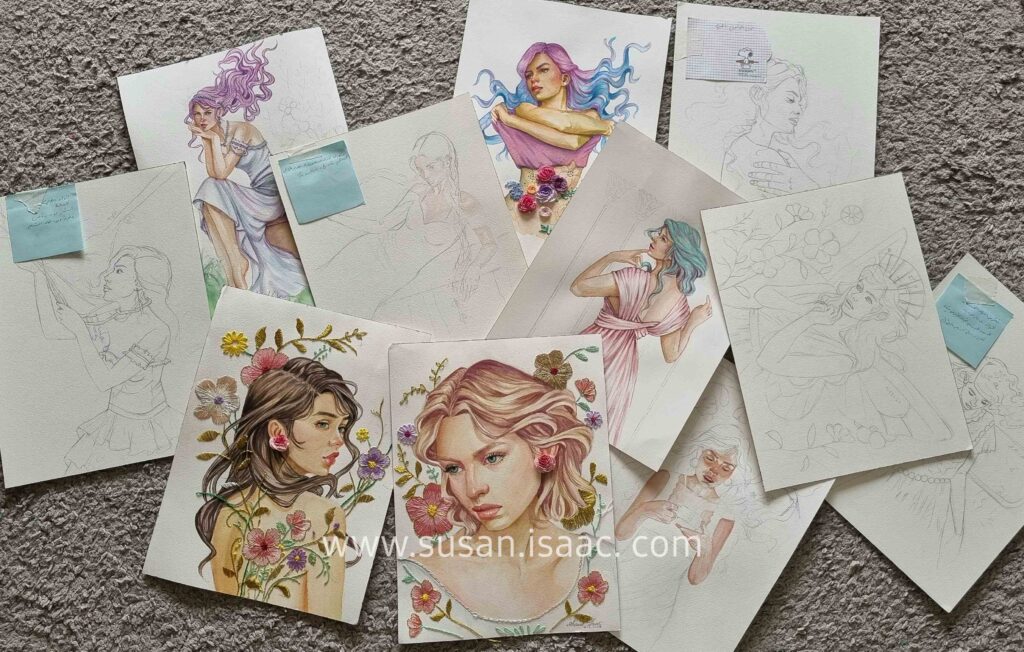
I rarely think about one artwork at a time.
When an idea comes to me, I don’t see a single painting,I see an entire series.
I like to think of an idea as the trunk of a tree. From that trunk, many branches can grow. Every new concept has the potential to become ten, fifteen, or even more artworks. Rather than focusing on one piece, I explore all the possibilities hidden within the idea.
For example, when I first started combining embroidery with paper, I didn’t think about creating one embroidered artwork. Instead, I began imagining all the different ways embroidery could interact with my paintings. Could it be stitched into a dress? Could it flow through the hair? Could it bloom behind a figure like a garden? Could it become a crown, a decoration, or even a symbolic extension of the character itself?
The same happened with my Egyptian doll series. I never imagined a single doll. I envisioned an entire collection of dolls, each with its own personality, symbolism, and story.
Once I have a theme in mind, I begin writing down every possibility that comes to me. I fill pages with notes, ideas, visual concepts, and small observations. At this stage, nothing is too simple or too ambitious. I allow myself complete freedom to explore.
The next step is sketching.
I always keep sketchbooks close by because they are an essential part of my creative process. My sketchbooks are private spaces where ideas are born. They are filled with quick drawings, rough compositions, notes, and experiments. These sketches are not meant to be perfect. Their purpose is simply to capture ideas before they disappear.
As I continue sketching, I gradually build a collection of possible artworks connected by the same theme.
Once I feel that the concept is strong enough, I begin thinking about practical details. I decide on the sizes of the pieces and determine which materials will work best for the project.
At this stage, I also gather references. Sometimes I use photographs I have taken myself, and other times I combine multiple reference images to create a completely new composition. Occasionally, I even use photographs of myself when I need a specific pose or expression.
The goal is never to copy a reference exactly. Instead, I use references as building blocks that help me create the final image I have imagined.
After collecting ideas, sketches, and references, I begin refining each composition. One by one, the rough sketches evolve into more detailed drawings. When I am satisfied with a design, I transfer it to its final surface, whether that is paper, canvas, or wood panel.
From there, the process depends on the materials I have chosen.
If I am creating a watercolor and embroidery piece, I usually complete the watercolor painting first. Once the painting is finished and dry, I begin the embroidery, adding texture and dimension with thread.
If I am working with oil paint and gold leaf, the process is different. In that case, I often prepare and apply the gold leaf before beginning the oil painting, allowing the materials to interact naturally throughout the work.
Because my ideas develop as collections rather than individual pieces, I am usually working on several artworks at the same time. While one painting is drying, another may be in the sketching stage, and a third may be receiving its final details.
This approach means that I rarely complete a painting from start to finish in a single session. Instead, I move between works, allowing each piece to evolve at its own pace.
Today, as a mother of young children, my studio time is often more limited than it once was. I work in smaller moments, fitting creativity into the rhythm of family life. Yet my process remains the same: ideas become sketches, sketches become series, and series become finished artworks.
For me, every painting begins long before the first brushstroke. It begins with curiosity, imagination, and the willingness to explore every branch of an idea before choosing where the journey will lead.