One of the questions artists often encounter is: Should the concept come first, or should the artwork come first?
Should we begin with a clear idea, a message, or a story and then create an artwork to express it? Or should we simply start creating and allow the meaning to develop through the process?
I don’t think there is one answer for every artist.
For me, it depends on where you are in your artistic journey.
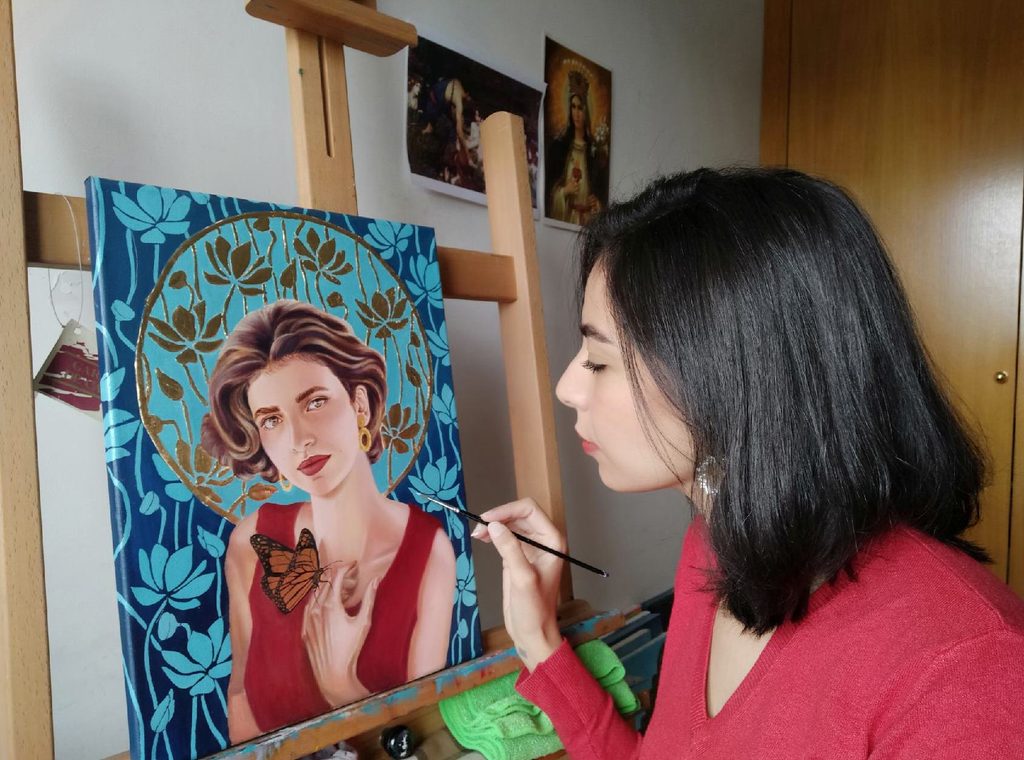
When You Are Still Finding Your Voice
When you are a beginner—or even when you have been creating for years but are still searching for your own artistic identity—I don’t believe you need to begin with a profound concept.
You need to begin with making art.
Draw. Paint. Experiment. Copy. Study other artists. Try different materials. Make mistakes. Make things you don’t like. Make things you unexpectedly love.
Create again and again.
Because when you are developing as an artist, you are not only learning technical skills. You are also discovering yourself.
Your artistic identity is not something that necessarily appears through thinking. It emerges through making.
You might spend hours asking yourself, What is my style? What makes my work unique? What do I want to say?
But sometimes the answer cannot be found by thinking about it.
You have to create your way toward it.
Your Artwork Leaves Clues
Every artwork you make contains hundreds of decisions.
You choose certain colors, shapes, compositions, textures, subjects, lines, materials, and ways of handling light and shadow.
At first, these decisions may seem completely unrelated.
But after creating many artworks, you may begin to notice something.
You keep returning to certain colors.
You repeatedly draw particular subjects.
You are attracted to specific shapes or compositions.
You use certain textures again and again.
Perhaps you are always fascinated by flowers, faces, architecture, animals, symbolic objects, or particular combinations of colors.
These repetitions are not necessarily signs that you lack originality.
They can be clues to your artistic identity.
Sometimes the things we naturally repeat are the things that genuinely belong to us.
Repetition Can Become Style
Artists often worry about repeating themselves.
We may think that if we paint the same subject again, use the same colors, or return to the same visual elements, people will think our work is predictable.
But I believe repetition can be one of the foundations of artistic style.
Think about an artist who repeatedly paints flowers.
At first, they may simply paint flowers because they enjoy them. Over time, they experiment with them. The flowers change shape, become symbolic, become surreal, or begin appearing in unexpected compositions.
Eventually, those flowers may become an unmistakable part of that artist’s visual language.
The artist didn’t necessarily decide at the beginning, “Flowers are going to be my signature.”
They discovered it through repetition.
The same can happen with color, composition, subject matter, technique, or even the way an artist handles a particular detail.
Style often develops from the things we repeatedly choose.
Quantity Is Important—But Not for the Reason You Think
This is why I believe quantity matters, particularly in the early stages of an artist’s development.
Not because making more artwork automatically makes you a better artist.
But because every artwork gives you another opportunity to learn.
One painting might teach you what you enjoy.
Another might show you what doesn’t work.
A mistake might lead to an unexpected technique.
An experiment with color might reveal a combination that feels completely natural to you.
You cannot discover all of these things by planning.
Some discoveries happen only when your hands are working.
The more decisions you make, the more opportunities you have to recognize which decisions feel genuinely yours.
And eventually, those decisions begin to form a visual language.
Then the Relationship With Concept Changes
But something changes when an artist has developed a stronger visual identity.
Once you have a visual language that feels like your own, you can begin with something else:
A concept.
A memory.
A question.
An emotion.
A personal experience.
A social issue.
Something you want to understand or communicate.
And now you have a language through which you can express it.
This is where concept becomes much more powerful.
Imagine ten artists working with exactly the same idea: memory.
One might create an abstract painting using layers of texture and muted colors.
Another might create fragmented portraits.
Another might use childhood objects.
Someone else might use embroidery, photography, sculpture, or surreal imagery.
The concept is the same.
The artworks are completely different.
Why?
Because the concept is only the starting point.
The artist is what transforms it.
The Concept Isn’t What Makes the Artwork Unique
Two artists can have the same idea and produce completely different artworks.
They bring their own experiences, cultural backgrounds, influences, emotions, techniques, and ways of seeing into the work.
This is why I believe that artistic identity is so important.
Without a personal visual language, an artwork can sometimes become an illustration of an idea.
The artist has something to say, but the visual language hasn’t yet become strong enough to make that message uniquely theirs.
But when an artist has developed a recognizable way of seeing, the concept passes through that language.
The same idea can become something completely personal.
And that is where individuality appears.
A concept does not automatically make an artwork memorable.
What makes it memorable is the way a particular artist gives that concept a visual form that could not have come from anyone else.
Don’t Be Afraid to Repeat Yourself
If you are currently trying to find your artistic style, I think it can be useful to look back at your old work.
Put several of your paintings or drawings next to each other.
Don’t judge them.
Just observe.
What keeps appearing?
Which colors do you repeatedly choose?
Which subjects attract you?
Are there shapes, symbols, textures, or techniques that you keep returning to?
You may discover that your artistic identity has been developing quietly for years.
Sometimes we are so focused on trying to invent a style that we fail to notice the one already emerging naturally.
And you don’t have to reinvent yourself with every artwork.
You are allowed to return to the same subjects.
You are allowed to explore the same colors.
You are allowed to develop the same visual ideas.
In fact, sometimes the deeper you go into something familiar, the more original it becomes.
Instead of constantly asking, “What can I do that I’ve never done before?”
Try asking:
“What can I discover by going deeper?”
So, Which Comes First?
So, which comes first—the concept or the artwork?
I think the answer depends on the artist.
If you are still searching for your artistic identity, make the artwork.
Experiment. Study. Practice. Repeat. Make mistakes. Follow your curiosity.
Don’t put pressure on yourself to make every artwork intellectually profound.
Sometimes you need to create simply to discover what you naturally gravitate toward.
But once you have developed a visual language that feels authentically yours, concepts can become powerful starting points.
You can begin with an idea and then ask:
How can I express this through my own visual language?
At that point, the concept and the artwork are no longer competing.
They become partners.
First, Discover the Language
Perhaps the real question isn’t:
“Should the concept come first or the artwork?”
Perhaps the better question is:
“Have I already discovered my own artistic language?”
If the answer is no, keep creating.
Your style may not need to be invented. It may need to be uncovered.
And the way to uncover it is through making—through hundreds of small decisions, experiments, failures, discoveries, and repetitions.
Then, when your visual language becomes stronger, you can use it to say something.
You can take your memories, questions, emotions, experiences, and ideas and transform them through a language that belongs to you.
First, discover the language.
Then, decide what you want to say with it.
Because people may remember a concept for a moment, but they remember an artist for the way only that artist could bring the concept to life.